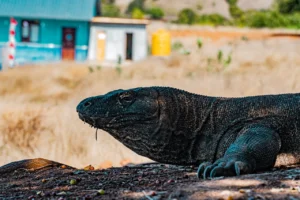
The Komodo dragon is one of the most remarkable animals in Indonesia. It is the largest living lizard in the world, yet its natural distribution is surprisingly small.
Unlike many other large reptiles that occupy wide geographic ranges, Komodo dragons are found only in a handful of islands in eastern Indonesia. Their remaining populations are associated with Komodo Island, Rinca, Gili Motang, Nusa Kode, and parts of western Flores.
So why don’t Komodo dragons live on more Indonesian islands?
The answer is more complicated than simply saying that Komodo dragons prefer certain islands. Their restricted distribution is the result of a combination of geography, habitat, food availability, isolation, evolutionary history, and human influence.
Where Do Komodo Dragons Live?
Today, Komodo dragons (Varanus komodoensis) have an extremely limited natural range in the Lesser Sunda Islands of Indonesia.
Four major island populations are located within Komodo National Park, while additional fragmented populations remain on the western part of Flores. Scientific studies have described the species as having an isolated island distribution, with populations separated from one another by stretches of sea.
Komodo and Rinca are the two largest islands supporting major populations within Komodo National Park. Smaller populations occur on islands such as Gili Motang and Nusa Kode.
This distribution is important because each island does not provide exactly the same environment. Island size, prey availability, vegetation, water availability, and population density can all influence how Komodo dragons survive.
Komodo Dragons Are Island Specialists
One of the biggest clues to their restricted distribution is the fact that Komodo dragons have become highly adapted to island environments.
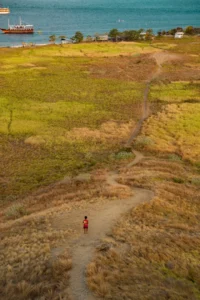
The islands where they live are relatively dry compared with many other parts of Indonesia. Their habitats include savanna, dry forest, coastal areas, and other environments that provide opportunities for hunting, scavenging, shelter, and thermoregulation.
Komodo dragons are also remarkably flexible predators.
They can hunt prey, consume carrion, and make use of resources available in their environment. A 2019 review of the species’ survival history suggests that their ecological flexibility including the ability to use marine-derived resources helped them persist despite major environmental changes over evolutionary time.
But being adaptable does not mean that Komodo dragons can live anywhere.
They still need a combination of suitable habitat and enough food to support a population.
The Sea Is a Major Barrier
Indonesia is an enormous archipelago, with thousands of islands separated by water.
For a terrestrial animal, even a relatively short stretch of ocean can be a significant barrier.
Komodo dragons are capable swimmers, but regularly crossing open water between islands is not the same as being able to establish a healthy population on every island they reach.
A dragon that reaches another island would still need to find:
- Suitable habitat
- Enough prey
- Nesting areas
- Shelter
- Freshwater resources
- Enough territory to survive and reproduce
This helps explain why the presence of nearby islands does not automatically mean that Komodo dragons can establish populations there.
Their current distribution is therefore shaped not only by the islands themselves, but also by the spaces between them.
Not Every Island Has the Right Habitat
Island size can make a major difference.
Komodo dragons are large predators with substantial food requirements. Larger islands can provide more habitat and potentially support larger prey populations.
Research conducted in Komodo National Park found clear demographic differences between dragon populations on larger and smaller islands. Large-island populations showed relatively stable population growth, while the study found evidence of decline in the Gili Motang population during the study period.
Another study comparing Rinca and Gili Motang found differences in body condition, abundance, and population characteristics, highlighting how island size and local ecological conditions can affect Komodo dragon populations.
In other words, an island can be geographically close to Komodo habitat and still be unsuitable for maintaining a large, stable population.
Food Availability Matters
Komodo dragons are apex predators, but even apex predators depend on the availability of prey.
Their diet can include large mammals as well as smaller animals and carrion. The availability of prey therefore plays an important role in determining whether an island can support a population.
If an island does not have enough suitable prey, a population of large carnivorous lizards may struggle to survive over the long term.
This is particularly important because the Komodo dragon’s enormous body size comes with energetic demands.
The relationship between island size, prey availability, and dragon populations is one reason scientists study individual island populations separately rather than treating all Komodo dragons as one uniform population.
Why Didn't Komodo Dragons Spread Across Indonesia?
At first glance, it might seem strange that Komodo dragons are not found across more of Indonesia.
After all, Indonesia contains thousands of islands with tropical climates.
But tropical does not automatically mean suitable for Komodo dragons.
Their present distribution is the result of a long evolutionary history. A 2019 scientific review notes that the Komodo dragon lineage evolved in Australia and later became restricted to islands in the Indonesian archipelago. Its survival was influenced by a combination of ecological flexibility, low energy requirements, habitat characteristics, and the history of human arrival.
Over very long periods, changes in climate, sea levels, habitats, prey communities, and human activity can dramatically change where a species can survive.
The islands where Komodo dragons remain today may therefore represent only a small portion of a much broader historical distribution.
Their Range Was Once Different
The modern distribution of the Komodo dragon should not necessarily be viewed as the species’ original range.
Fossil and evolutionary evidence suggests that the history of the Komodo dragon is much older and geographically broader than its modern distribution.
Today, the species survives in a restricted island environment, making it an unusual example of a large predator persisting in a relatively small geographic area. Researchers have described this persistence as particularly remarkable because many other large-bodied animals disappeared during major periods of megafaunal extinction.
This gives the Komodo dragon a fascinating evolutionary story:
A giant predator evolved in a much broader ancient environment, but today survives only in a small part of the Indonesian archipelago.
What About Flores?
Flores is especially interesting because it is much larger than the small islands of Komodo National Park.
Several fragmented Komodo dragon populations persist on the western part of Flores.
However, these populations face a different set of pressures from those living inside Komodo National Park.
Scientific research has identified habitat loss and the removal of important prey species as potential threats to Komodo dragons, particularly outside protected areas.
This demonstrates another important point:
A large island does not automatically guarantee a secure Komodo dragon population.
The quality and continuity of habitat matter just as much as the physical size of the island.
Why Are Komodo Dragons So Vulnerable to Changes in Their Environment?
Having populations spread across several islands might seem like an advantage.
In some ways, it is.
If something affects one island, populations on another island may remain unaffected.
But isolated populations also have a major weakness: they cannot easily exchange individuals with distant populations.
When populations are separated by the sea, a local decline can become much more difficult to reverse naturally.
This is why scientists emphasize island-specific population monitoring and conservation. Research in Komodo National Park has found substantial differences in population dynamics between islands, suggesting that conservation strategies cannot simply treat every island population in exactly the same way.
Could Komodo Dragons Naturally Expand to New Islands?
In theory, a Komodo dragon could reach another island.
But reaching an island is only the first step.
For a new population to become established, enough individuals would need to survive, reproduce, find adequate food, and persist for many generations.
The island would also need to provide suitable habitat and enough prey.
This makes natural expansion difficult.
The sea creates a physical barrier, while ecological requirements create another barrier after an animal reaches land.
So the question isn’t simply:
“Can a Komodo dragon get to another island?”
The more important question is:
“Can a population of Komodo dragons survive there for generations?”
That is a much higher bar.
Why This Makes Komodo National Park So Important
The limited distribution of Komodo dragons makes the protection of their remaining habitat especially important.
Komodo National Park contains major populations on several islands and protects not only terrestrial habitat but also extensive marine areas.
Scientific monitoring has shown that populations can behave differently from one island to another. A long-term study of Komodo National Park estimated approximately 2,448 dragons across the studied park populations, with a 95% confidence interval of 2,067–2,922 at the time of that research.
These numbers should not be interpreted as a permanent population count. Wildlife populations change over time, and scientific estimates depend on the survey period and methodology.
What the research does show is that protecting the islands and their individual populations is critical to the species’ long-term survival.
The Real Reason Komodo Dragons Live on So Few Islands
There isn’t one single explanation.
Komodo dragons are restricted to a small number of islands because several factors have worked together over thousands and millions of years.
These include:
- Geographic isolation — the sea separates populations from one another.
- Specific habitat requirements — not every Indonesian island provides the right combination of habitat and climate.
- Prey availability — large predators need enough food to maintain viable populations.
- Island size — larger islands can provide more habitat and resources.
- Evolutionary history — today’s distribution is the result of a long and complex history.
- Human impacts — habitat conversion and changes in prey populations can reduce suitable habitat outside protected areas.
- Population isolation — small island populations can be particularly vulnerable when their numbers decline.
The Komodo dragon’s restricted range is therefore not simply a matter of preference.
It is the result of evolution, geography, ecology, and human history interacting over a very long period of time.
A Giant Predator in a Very Small World
Perhaps the most fascinating thing about Komodo dragons is the contrast between their size and their geographic range.
They are enormous predators capable of hunting large prey, yet their natural world is limited to a handful of islands in eastern Indonesia.
That makes every island important.
Komodo, Rinca, Gili Motang, Nusa Kode, and the remaining populations on western Flores are not simply locations where tourists can see Komodo dragons. They are pieces of a much larger evolutionary story.
And that is why protecting Komodo dragons means protecting more than the animals themselves.
It means protecting the islands, forests, savannas, prey species, nesting habitats, and ecological relationships that allow this extraordinary reptile to survive.
If you want to experience the feeling of seeing a Komodo dragon up close in the wild, you can book your Komodo trip through https://komodotour.com.au and experience it for yourself.
Komodo Dragons FAQ
Learn more about where Komodo dragons live, how they move between islands, and why their distribution is so limited.
Are Komodo dragons found only on Komodo Island? +
No. Komodo dragons are not restricted to Komodo Island. Their remaining natural populations are distributed across several islands in eastern Indonesia, including Komodo, Rinca, Gili Motang, Nusa Kode, and parts of western Flores.
Can Komodo dragons swim between islands? +
Yes, Komodo dragons are capable swimmers. However, being able to swim does not mean they can easily establish populations on every island. A new population would still require suitable habitat, prey, nesting areas, and enough individuals to reproduce successfully.
Why don't Komodo dragons live throughout Indonesia? +
Indonesia contains many different ecosystems. Komodo dragons require particular combinations of habitat, food resources, and environmental conditions. Their current range is also shaped by their evolutionary history and the geographic isolation of island populations.
Are Komodo dragons endangered? +
The species has a highly restricted distribution and faces conservation pressures, including habitat and prey-related threats. Their isolated island populations also make them particularly sensitive to environmental changes.
Why are Komodo dragons important to the ecosystem? +
As apex predators and scavengers, Komodo dragons occupy an important position in their island ecosystems. Their presence is connected to the populations of prey animals and the broader ecological processes of the islands where they live.
Why Their Limited Range Matters
The question of why Komodo dragons are found on so few islands reveals something much bigger than the distribution of a single reptile.
Their limited range is a window into island evolution.
Separated by the sea, exposed to changing environments, and dependent on limited island resources, Komodo dragons have survived where many other large animals disappeared.
That is what makes seeing a Komodo dragon in the wild so extraordinary.
You are not simply seeing a large lizard. You are seeing one of the last surviving representatives of an ancient evolutionary story, one that is now confined to a remarkably small corner of Indonesia.