At first glance, a lizard, a monitor lizard, and a Komodo dragon may seem like variations of the same kind of animal. They all have scales, four legs, long tails, and the familiar appearance of reptiles.
But once you look more closely, the differences become much more interesting.
A small lizard can easily fit in your hand, while a monitor lizard can grow to a size that makes it look much more intimidating. Then there is the Komodo dragon, a giant monitor lizard that can reach around three meters in length and is built for hunting much larger prey.
So, what really separates these three?
The Lizard: Small, Fast, and Adaptable
The word “lizard” covers a huge variety of reptiles. Many species are relatively small and have slender bodies, making them quick and agile.
Depending on the species, lizards can eat insects, fruits, small animals, or a combination of different foods. They can also live in many different environments, from gardens and forests to rocky areas.
Their smaller size is often one of their biggest advantages. When threatened, many lizards rely on speed to escape predators rather than confronting them.
The Monitor Lizard: A Much Bigger Predator
Monitor lizards belong to the genus Varanus, which includes many species found across Africa, Asia, and Australia.
Compared with most familiar lizards, monitor lizards have stronger bodies, powerful legs, long tails, and sharp claws. They are also active predators and scavengers.
Their forked tongues are another distinctive feature. They constantly move their tongues to collect particles from the environment, which are then analyzed using a specialized sensory organ in the mouth.
This helps them locate food and follow scent trails.
Monitor lizards come in many sizes. Some species are relatively small, while others can become very large.
And among them is one species that takes size to another level.
The Komodo Dragon: The Giant of the Monitor Lizard Family
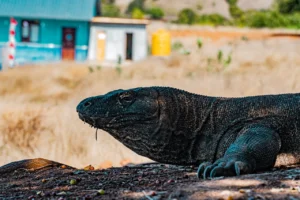
The Komodo dragon, Varanus komodoensis, is the largest living lizard species.
It is a member of the same monitor lizard family, but its enormous body, powerful limbs, and hunting ability make it very different from the small lizards most people encounter.
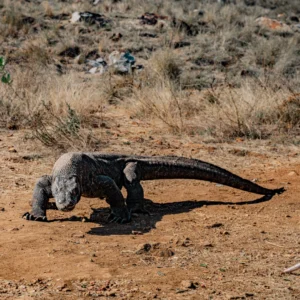
Adult Komodo dragons can grow to around three meters long. They have muscular bodies, strong jaws, sharp claws, and a powerful tail.
Their diet can include large animals such as deer and wild pigs, as well as carrion.
Unlike the small lizards that often disappear into bushes or cracks when disturbed, a Komodo dragon has the size and strength to dominate its environment.
So, Are They Related?
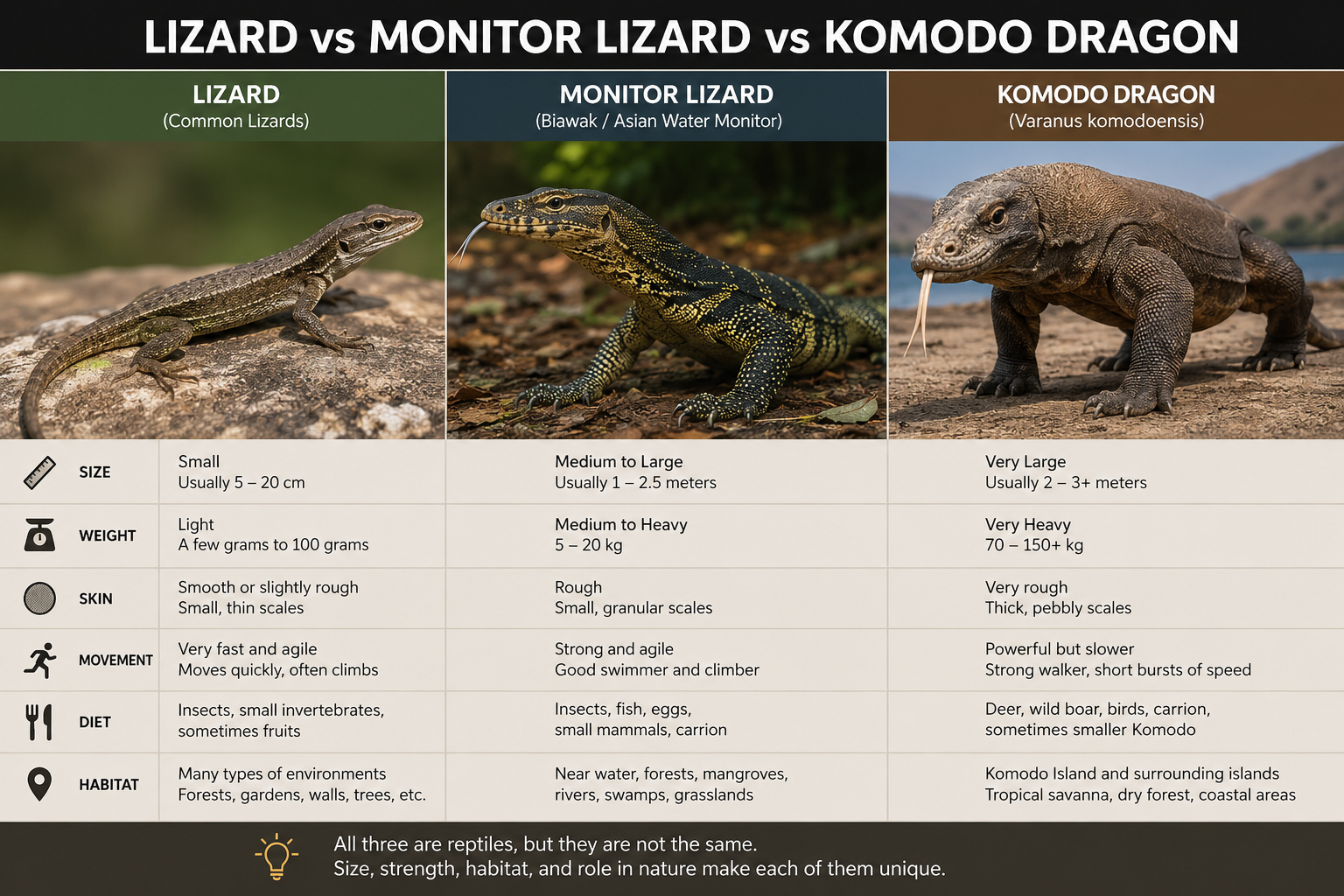
Yes.
This is perhaps the most interesting part of the comparison.
A Komodo dragon is not simply a giant version of an ordinary garden lizard. It is specifically a species of monitor lizard.
In simple terms:
Lizard → Monitor lizard → Komodo dragon
The three are connected through their broader reptile classification, while monitor lizards belong to the family Varanidae and the Komodo dragon is one particular species within the genus Varanus.
The similarities become easier to understand when you look at their body structure, especially the long tail, strong legs, claws, scales, and forked tongue.
Size Is Only Part of the Story
It is tempting to think that the main difference between them is simply size.
But size is only one part of the story.
Their lifestyles, diets, behavior, habitats, and hunting strategies can also be very different. A small lizard may spend much of its time searching for insects, while a large monitor lizard can actively hunt or scavenge larger animals.
The Komodo dragon takes this adaptation even further. Its large body allows it to hunt prey that would be impossible for a typical small lizard to tackle.
Seeing a Komodo Dragon in Person Is Different
Pictures can give you an idea of how large a Komodo dragon is, but seeing one in its natural environment can be a completely different experience.
After seeing ordinary lizards and monitor lizards, you might think you already know what a large lizard looks like.
Then you see a Komodo dragon.
The heavy body, powerful legs, long tail, and slow but deliberate movements make it immediately clear that this is something on another level.
It may look familiar because it shares many characteristics with other lizards, but its size and presence make it unmistakable.
That is part of what makes seeing a Komodo dragon in Komodo National Park such a memorable experience.