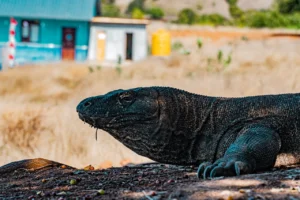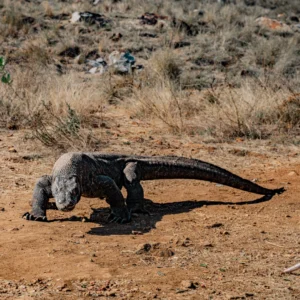
The Komodo dragon is one of the most remarkable animals found in Indonesia. It is the world’s largest living lizard and is naturally found only in a small part of eastern Indonesia.
But how many Komodo dragons are left in the world in 2026?
The answer is not a single exact number.
Based on the latest population information published by Indonesia’s Ministry of Forestry in 2026, an estimated 3,270 ± 371 Komodo dragons live within Komodo National Park, while approximately 701 ± 131 individuals remain on Flores Island. The government also reports 177 Komodo dragons in ex-situ conservation areas.
These figures show why it is important to look at the location and type of population being counted when discussing the number of Komodo dragons remaining today.
How Many Komodo Dragons Are Left in 2026?
The latest government information gives the following population estimates:
| Location | Estimated population |
|---|---|
| Komodo National Park | 3,270 ± 371 |
| Flores Island outside the national park | 701 ± 131 |
| Ex-situ conservation areas | 177 |
| Total of these reported groups | 4,148 ± 502* |
*The combined uncertainty is shown here as a simple addition of the reported margins and should not be treated as an official single population estimate. The government reports these groups separately.
For a travel article, it is therefore safer to say that more than 4,000 Komodo dragons are represented across the latest reported wild and conservation populations, rather than claiming that exactly 4,148 Komodo dragons exist in the world.
The most important figure for visitors to Komodo National Park is the estimate of 3,270 ± 371 individuals inside the park. This estimate came from monitoring conducted from March to October 2024 and remains the latest detailed national-park population figure referenced in current government conservation information.
Why Do Different Websites Give Different Numbers?
If you search online for the Komodo dragon population, you may find several different numbers.
Some older articles mention around 3,000 animals. Others mention approximately 5,700, while some sources focus on around 1,300 mature individuals.
This does not necessarily mean that one source is wrong.
Population figures can represent different years, locations, age groups or methods of assessment.
For example, the IUCN Red List uses population parameters such as the number of mature individuals when applying its conservation criteria. That is not necessarily the same thing as counting every Komodo dragon, including juveniles.
This is why the year and definition behind a population number matter.
For 2026, the latest Indonesian government information provides one of the clearest current references for understanding the Komodo dragon population.
Where Do Komodo Dragons Live?
Komodo dragons are endemic to Indonesia.
Their natural distribution is limited to parts of Flores Island and several nearby islands, including the islands within Komodo National Park.
The main populations associated with Komodo National Park are found on:
- Komodo Island
- Rinca Island
- Gili Motang
- Nusa Kode
- Padar Island
Monitoring data from Komodo National Park in 2024 estimated:
| Island | Estimated Komodo dragons |
|---|---|
| Komodo Island | 1,619 |
| Rinca Island | 1,472 |
| Gili Motang | 74 |
| Nusa Kode | 77 |
| Padar Island | 28 |
| Total | 3,270 |
Komodo Island and Rinca account for the vast majority of the population inside the national park.
This distribution is one of the reasons Komodo National Park is so important. The species does not have a large geographic range spread across different countries. Its entire natural distribution is concentrated in Indonesia.
What About Komodo Dragons on Flores?
Komodo dragons are not found only inside Komodo National Park.
A significant population also survives on Flores Island, where the latest government information estimates approximately 701 ± 131 individuals. These populations occur in areas including parts of northern and western Flores.
This is an important point that is sometimes missed in travel articles.
When people think about Komodo dragons, they often immediately think of Komodo Island. However, Flores is also an important part of the species’ remaining natural range.
Has the Komodo Dragon Population Been Increasing?
The answer depends on the location and the period being considered.
Long-term monitoring in Komodo National Park has shown fluctuations rather than a perfectly straight upward or downward trend.
The reported national-park population was:
| Year | Estimated population |
|---|---|
| 2018 | 2,897 |
| 2019 | 3,022 |
| 2020 | 3,163 |
| 2021 | 3,303 |
| 2022 | 3,156 |
| 2023 | 3,396 |
| 2024 | 3,270 |
The park authority has described the population as relatively stable, while noting that natural fluctuations can occur depending on prey availability and ecological conditions.
The 2024 figure of 3,270 is therefore better understood as part of an ongoing monitoring program rather than an exact annual headcount.
Are Komodo Dragons Endangered?
Yes.
The Komodo dragon, scientifically known as Varanus komodoensis, is classified as Endangered on the IUCN Red List.
Indonesia’s Ministry of Forestry also describes the species as endangered and notes that its conservation faces several challenges, including habitat degradation, illegal hunting, hunting of Komodo prey such as deer, human-wildlife conflict and invasive species such as free-roaming dogs.
Being classified as Endangered does not mean that only a few hundred Komodo dragons remain.
Conservation status considers more than simply the total number of animals. The species’ restricted geographic distribution and the threats affecting its habitat and prey are also important.
What Threatens Komodo Dragons?
Habitat degradation
Komodo dragons depend on relatively intact island ecosystems.
Changes to their habitat can reduce the areas available for feeding, shelter and reproduction.
Because their natural range is already small, habitat loss in one area can have a greater impact than it might for a species with a much wider distribution.
Declining prey
Komodo dragons are apex predators and depend on prey animals such as Timor deer.
The Indonesian government identifies hunting of prey species as one of the challenges facing Komodo conservation. A reduction in available prey can affect the ecological conditions needed to support Komodo populations.
Human-wildlife conflict
As human activity expands around parts of the Komodo dragon’s range, interactions between people and wildlife can become a conservation concern.
This is particularly relevant on Flores, where Komodo populations exist outside the boundaries of Komodo National Park.
Invasive species
The Ministry of Forestry has also identified free-roaming or invasive dogs as a concern in Komodo dragon habitat. Such species can interact with native wildlife and potentially affect the ecosystem on which Komodo dragons depend.
Climate and environmental changes
The future of Komodo dragons is also connected to broader environmental changes affecting the small islands where they live.
Because the species has such a restricted geographic range, long-term changes to its habitat and surrounding ecosystems are an important consideration for conservation planning.
Is the Komodo Dragon Population Safe Now?
The latest population figures do not mean that the conservation problem is over.
Government conservation programs describe the population inside Komodo National Park as relatively stable, but the species remains classified as Endangered. The Indonesian government has therefore continued conservation planning through the Komodo Species Conservation Action Plan, or SRAK Komodo, covering the 2025–2035 period.
The plan brings together government agencies, conservation organizations and other stakeholders to address threats and maintain viable Komodo populations.
In other words, a stable population today does not mean that the species no longer needs protection.
Can You See Komodo Dragons in the Wild?
Yes.
Komodo National Park provides visitors with an opportunity to see Komodo dragons in their natural habitat.
Komodo Island and Rinca Island are among the main destinations for wildlife encounters.
However, these animals are wild predators and should always be observed responsibly.
Visitors should:
- Stay with the designated ranger or guide
- Keep a safe distance from Komodo dragons
- Never feed the animals
- Avoid sudden movements
- Follow national park regulations
- Never attempt to touch or approach a Komodo dragon
The goal of a wildlife encounter is not simply to get a photograph. It is to observe the animal without disturbing its natural behavior.
Why Is Komodo National Park So Important?
Komodo National Park protects one of the world’s most distinctive reptile species together with the wider ecosystem that supports it.
The park is not only about Komodo dragons.
Its terrestrial and marine environments include coral reefs, mangroves, seagrass areas, beaches and numerous other species.
For travelers visiting Labuan Bajo, this means a Komodo trip can offer much more than a Komodo dragon encounter.
A typical journey through the national park can include places such as Padar Island, Pink Beach, Komodo Island and several snorkeling or marine sites.
The wildlife is part of a much larger ecosystem.
So, How Many Komodo Dragons Are Left in the World?
Based on the latest Indonesian government information available in 2026, the most useful figures are:
Around 3,270 ± 371 Komodo dragons are estimated within Komodo National Park, with another 701 ± 131 estimated on Flores Island. The government also reports 177 individuals in ex-situ conservation areas.
These figures should not be presented as an exact worldwide headcount because they represent separate population estimates and conservation categories.
What we can say with confidence is that the Komodo dragon remains a species with a very restricted natural distribution and an estimated population in the low thousands.
Its survival depends on protecting not only the animals themselves, but also the forests, savannas, prey species and coastal ecosystems of the islands where they live.
For anyone visiting Komodo National Park, seeing one of these animals in the wild is therefore more than a tourism experience. It is an opportunity to observe one of Indonesia’s most distinctive species in one of the few places on Earth where it still survives naturally.
Frequently Asked Questions (FAQs)
How many Komodo dragons are left in the world in 2026?
The latest Indonesian government information estimates 3,270 ± 371 Komodo dragons inside Komodo National Park and approximately 701 ± 131 on Flores Island. An additional 177 individuals are reported in ex-situ conservation areas.
Are there more than 4,000 Komodo dragons?
The reported figures total approximately 4,148 individuals when the Komodo National Park, Flores and ex-situ figures are added together. However, these are separate reported groups with their own uncertainty and should not be presented as an exact global census.
Where are most Komodo dragons found?
Most of the monitored population within Komodo National Park is found on Komodo Island and Rinca Island. The 2024 monitoring estimated 1,619 on Komodo Island and 1,472 on Rinca.
Are Komodo dragons endangered?
Yes. The Komodo dragon is classified as Endangered on the IUCN Red List. Indonesia is also implementing a species conservation action plan covering 2025–2035.
Can tourists see Komodo dragons?
Yes. Visitors to Komodo National Park can observe wild Komodo dragons at designated locations, following the instructions of park rangers and local regulations.
What is the scientific name of the Komodo dragon?
The scientific name of the Komodo dragon is Varanus komodoensis.
Are Komodo dragons found outside Indonesia?
No. The Komodo dragon is endemic to Indonesia. Its natural range is limited to Flores and nearby islands in East Nusa Tenggara.